Carbon Governance in Southeast Asia
About Us
Carbon Governance in Southeast Asia, or CGSEA, is an online platform for the exchange of interdisciplinary knowledge, ideas and developments relating to the research project on Climate Governance of Nature-based Carbon Sinks in Southeast Asia. The research project is funded by the Social Science Research Thematic Grant (SSRTG) from the Ministry of Education, Singapore, Social Science Research Thematic Grant (SSRTG) MOE2021-SSRTG-021.
The research project is hosted at the Asia Research Institute and builds upon the research on Sustainable Governance of the Transboundary Environmental Commons in Southeast Asia which was completed in June 2022.
Our Work
The Carbon Governance in Southeast Asia grant is an interdisciplinary coming together of scholars whose interests range across various disciplines in the natural and social sciences. As such, our teams collaborate on specific work packages that address a particular kind of carbon sink–terrestrial forests, coastal and freshwater ecosystems, and peatlands and agricultural soils, each headed by a Postdoctoral Research Fellow. Our last work package, systems, technologies and social relations, aims to compare, contrast and integrate findings from the empirical research of the other three to produce compelling, insight-rich social science research, and is headed by our Senior Research fellow. To learn more about each work package, please browse the links below:



Latest News

Follow us on social media! 
Helena Varkkey was an invited guest commenting on Global and Regional Cooperation on Air Quality for State of Global Air’s Science on the 7th interview series, where she shared her expertise on the causes and environmental effects, as well as the politics and regulation of, transboundary haze in Southeast Asia. 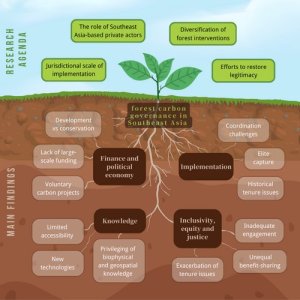
CGSEA Research Fellow Yingshan Lau was interviewed by Mongabay for a feature on her lead-authored review paper on ‘Challenges in Forest Carbon Governance: Insights From Southeast Asia’, co-authored with other researchers from the project’s team working on Terrestrial Forests. To read the full feature, click here. 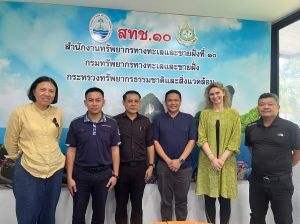
Michelle Miller and Jay Quevedo undertook fieldwork in Krabi Province, Thailand, from 23-30 November 2025. 
Dixon Gevaña was invited to give a plenary talk on ‘Mangrove conservation promoting sustainable ecotourism and local livelihoods’ at the 3rd International Conference on Biodiversity and Sustainable Development 2025. 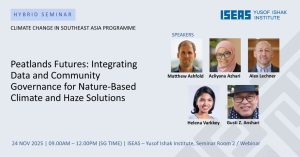
Helena Varkkey was invited to speak on ‘Knowledge Co-Creation with Peatland Communities for Improved Peatland Governance’ for a hybrid seminar organised by the Institute for Southeast Asian Studies (ISEAS). In addition to delivering her talk, Varkkey also launched a policy brief on community-centred actions for improved peatland governance and the implementation of nature-based solutions (NbS), which she led the writing of. 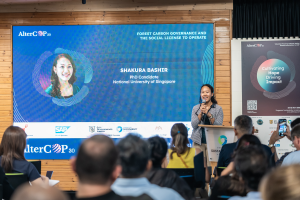
PhD Affiliate Shakura Bashir presented on ‘Forest Carbon Governance and the Social License to Operate’ at AlterCOP 30. 
Prayoto Tonoto was invited to participate in a Bilateral Exchange between the Government of Indonesia and the Government of Vietnam, in Hanoi, Vietnam, on 3-6 November 2025. 
Danny Marks and Janice Lee have been appointed Lead Authors for Working Group II (Impacts, Adaptation and Vulnerability) of the Intergovernmental Panel on Climate Change’s (IPCC) Seventh Assessment Report (AR7). 
CGSEA researchers’ review article, led by PhD Student Yuchuan Zhou, on ‘Transparency, robustness, and consistency in aboveground forest carbon quantification methodologies used for tropical forest carbon projects’, has been published open access in Carbon Balance and Management. To read the full paper, click here. 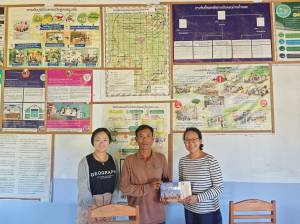
Yunrui Ren and Shakura Bashir undertook fieldwork at a forestry project site in Laos from 26 October-3 November, 2025, where they conducted surveys and focus group discussions with various respondents at the Burapha Afforestation, Reforestation and Revegetation (ARR) site in Laos. 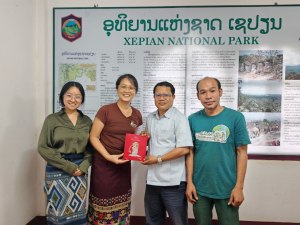
Yingshan Lau and Yunrui Ren undertook fieldwork at the Xe Pian National Park REDD+ project site in Laos from 14-16 October, 2025, where they visited the Xe Pian National Park REDD+ project site as part of ongoing research on the forest carbon landscape in Laos. 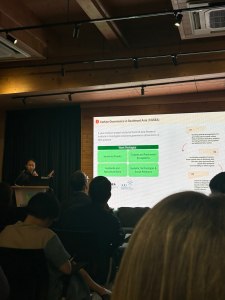
Shakura Bashir was invited to speak on ‘Beyond Carbon: Towards a Holistic Assessment of Integrity and the Role of Governance’ at Getting Ahead of the Carbon Curve, an event co-organised by the Centre for Nature-based Climate Solutions at NUS, the NUS Sustainability Academy, and The Nature Conservancy, on 15 October. 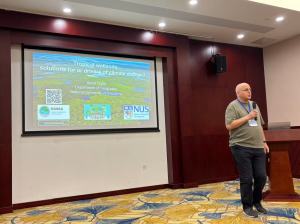
David Taylor completed a visit to China, where he was invited to deliver a keynote on ‘Tropical Wetlands: Solutions for or drivers of climate change’ at the 2025 Maritime Silk Road International Conference, co-organised by Yunnan University and Lanzhou University, on 12 October. The following week, he was invited to present a similar talk at a research seminar for the School of Earth and Environmental Sciences, Lanzhou University, on 20 October. 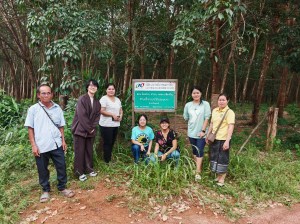
Yunrui Ren and Shakura Bashir undertook fieldwork at a forestry project site in Laos from September 23-29, 2025. 
Michelle Miller, Jay Quevedo and Saritha Uda met the Vice Rector for International Collaborations at Universitas Tanjungpura (UNTAN), Prof. Rustamaji, on September 24, 2025. 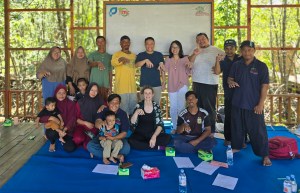
Michelle Miller, Jay Quevedo and Saritha Uda undertook fieldwork in Mempawah Regency, West Kalimantan, Indonesia from 22-28 September 2025. 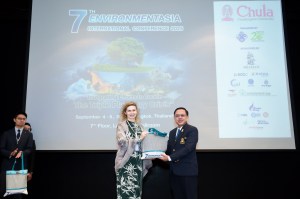
Michelle Miller was invited to speak on ‘A Transboundary Agenda for Nature-Based Solutions: Crossing the Urban-Rural Divide in Southeast Asia’ at the 7th EnvironmentAsia International Conference 2025. 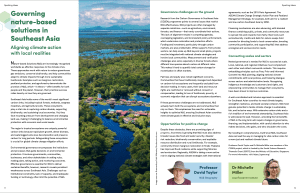
The CGSEA project was featured in Ignite Magazine, a publication of the Office of the Deputy President (Research & Technology) of the National University of Singapore (NUS). To read the full feature, click here.
Call for Papers
Miller MA & Taylor D [Special Issue] Natural Climate Solutions in Southeast Asia: Positioning Local Carbon Transitions within Global Frameworks. Environmental Policy and Governance.
CGSEA invites submissions for a Special Issue in Enviornmental Policy and Governance examining linkages between Natural Climate Solutions in the tropics and international climate policy and governance frameworks. We invite the submission of abstracts concerned with these themes and issues, grounded in examples from tropical developing countries. In particular, we encourage studies focused on the following themes:
- Multilevel nature-based governance
- Innovations / replications in NCS governance
- Equity, Justice and Community Engagement in NCS Policy and Governance
To propose a contribution to this special issue, please submit an extended 500-800 word abstract outlining the research question(s), theoretical and conceptual contribution, case study, methods, data sources and the relevance of your study to this special issue. In addition, please include a short biographical statement for each (co-)author not exceeding 100 words.
The submission timeline for this special issue is as follows:
- Extended abstract submission: Friday, 28th November 2025 (please send your abstract to michelle.miller@nus.edu.sg)
- Notification of abstract acceptance: Friday, 19th December 2025
- Full paper submission: Friday, 10th April 2026
For more information on this special issue, please click here.
 Carbon Governance in Southeast Asia (CGSEA)